Your Pantry Is a Paint Store: The Mad Kitchen Chemists Brewing Art Supplies From Scratch
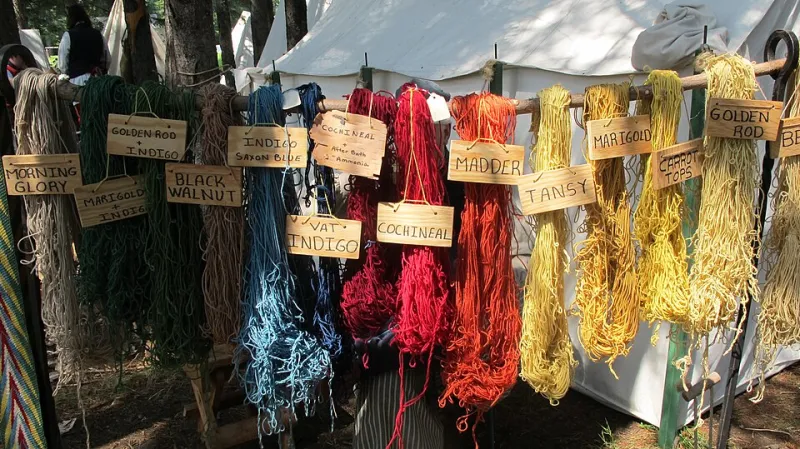
Photo: NPS, Public domain, via Wikimedia Commons
There's a jar of turmeric on Dani Reyes's kitchen counter that has never once touched food. Next to it sits a half-empty bottle of white vinegar, a box of baking soda with the top torn clean off, and a mason jar full of something deeply, aggressively orange. Dani is not cooking dinner. Dani is making paint.
"My roommates think I've lost it," she says, laughing, from her apartment in Austin, Texas. "But I haven't bought a single commercial art supply in eight months. Everything I need is already in here."
Dani is part of a loose, loud, and gloriously chaotic movement of crafters who have decided that the art supply industry can take a long walk off a short pier. Armed with nothing but curiosity, a tolerance for mess, and a pantry full of everyday ingredients, these kitchen chemists are formulating their own pigments, binders, adhesives, and texture pastes — and the results are genuinely stunning.
The Revolution Starts With Beet Juice
Natural pigment-making isn't new — humans were grinding berries and charcoal into cave walls long before Winsor & Newton existed — but the current wave has a distinctly rebellious, share-everything, screw-the-gatekeepers energy that feels fresh.
The process is more approachable than you'd think. Boil red cabbage down and you get a moody, shifting purple that changes color depending on whether you mix it with something acidic or alkaline. Turmeric suspended in a little rubbing alcohol produces a saturated golden yellow that absolutely pops on dark paper. Walnut husks (if you can get them) yield a rich, warm brown that painters have actually used for centuries — though most people just throw them in the trash.
Beet juice, reduced on the stovetop and thickened with a pinch of cornstarch, becomes a surprisingly workable watercolor medium. Spinach. Coffee grounds. Onion skins. The list of potential pigment sources sitting in the average American kitchen is genuinely wild once you start paying attention.
"I got obsessed during a stretch where I was totally broke," admits Marcus Webb, a mixed-media artist based in Detroit who documents his experiments on Instagram. "I couldn't afford supplies, so I started treating my kitchen like a chemistry lab. Now I could afford them and I still don't want them. Commercial paints feel boring to me now. There's no story in a tube."
Glue, Gesso, and the Art of Improvisation
Pigment is just the beginning. The underground pantry-craft movement has also cracked adhesives and grounds — the stuff you use to stick things together and prep your surfaces.
Flour paste (just cooked flour and water, basically) has been used as a bookbinding adhesive for centuries and works beautifully for collage and paper arts. Add a little salt to discourage mold and you've got something that rivals many commercial PVA glues for certain applications. Crafters in online forums have documented using everything from rice paste to tapioca starch as workable glue alternatives, each with slightly different properties and textures.
For gesso — the white ground traditionally painted on canvas before you start — some kitchen crafters have had success with a mix of white chalk powder (calcium carbonate, which you can find cheap at garden supply stores), a little cornstarch, and diluted white craft glue or even homemade flour paste. It's not identical to commercial gesso, but it works, it's cheap, and making it yourself feels like pulling off a small heist against the art supply industrial complex.
Texture paste is where things get truly unhinged in the best possible way. Baking soda mixed with white school glue creates a paste that dries hard and grainy, perfect for building up surface texture in mixed media work. Add coffee grounds for a coarser grit. Add fine sand from the hardware store. Add dried herbs. The combinations are endless and each batch comes out different.
"I made a whole series of abstract pieces using texture paste built from baking soda, espresso grounds, and a little red food coloring," says Priya Okafor, a crafter and art teacher in Chicago. "They look like alien landscapes. A gallery actually wanted to show them. When I told the curator what they were made of, she thought I was joking."
The Chemistry Nobody Taught You in School
Part of what makes this community tick is the genuine delight in discovering that chemistry is happening in your kitchen all the time, and you can redirect it.
Vinegar and baking soda are the classic duo — most famous for elementary school volcanoes — but crafters have figured out that the carbon dioxide reaction can be used to create interesting surface textures in paint and plaster-like materials as they cure. Salt, when sprinkled onto wet watercolor paint, pulls the pigment outward as it dries, creating crystalline, organic patterns that no brush technique can quite replicate. It's a well-known watercolor trick, but the pantry-craft crowd has pushed it into stranger territory, using it with homemade pigments on unconventional surfaces.
Food coloring, meanwhile, gets a serious rehabilitation in this world. Often dismissed as a kid's craft supply, it becomes genuinely powerful when you start layering it, mixing it with unexpected binders, or using alcohol-based food coloring on non-porous surfaces where it behaves completely differently than it would on paper.
"People underestimate food coloring because they associate it with frosting a birthday cake," says Marcus. "But drop some on a piece of synthetic fabric and hit it with rubbing alcohol and suddenly you've got something that looks like a high-end alcohol ink piece. It's the same physics. The supply companies just charge you forty times more to call it 'ink.'"
Why This Matters Beyond the Cool Factor
There's a practical dimension here that goes beyond rebellion for its own sake. Commercial art supplies are expensive, and the cost is a genuine barrier that keeps people out of creative practice. When a single tube of professional-grade oil paint can run fifteen to twenty-five dollars, building a full palette becomes a serious financial commitment.
The pantry-craft movement democratizes that. It says: you don't need permission, you don't need money, and you don't need a trip to the craft store to make something real. Your kitchen is already stocked. The store is already open.
It also quietly sidesteps some of the environmental concerns embedded in commercial art supply production — synthetic pigments, plastic packaging, shipping emissions — by using what's already there, in packaging you were already going to have.
None of that means kitchen-brewed supplies are always better than commercial ones. They're not. Natural pigments fade faster. Flour paste isn't waterproof. Homemade gesso can crack. The outlaws in this community know this and mostly don't care — or they treat the impermanence as part of the point.
"My work is going to fade," Dani says, completely unbothered. "So is everything else. At least mine smells like turmeric while it's here."
Honestly? That's the most punk thing we've heard all week.