Break It Till You Make It: The Makers Who Threw Out the Tutorial and Found Their Voice in the Wreckage
Somewhere between step four and step seven, Dani Reyes lost her mind.
She'd been following a resin pour tutorial to the letter — the right ratios, the right mold, the right temperature — and still ended up with a bubbled, lopsided, weirdly beautiful mess that looked nothing like the glossy pendant in the video thumbnail. She stared at it for a long time. Then she kept it.
"That piece sold first at my next market," says Reyes, a mixed-media artist based out of Albuquerque, New Mexico. "People kept asking what technique I used. I told them: catastrophic failure. They thought I was joking."
She wasn't. And she's not alone.
Across the country, a loose and loudly unapologetic community of makers is pushing back against what some are calling the Tutorial Industrial Complex — the endless scroll of perfectly lit, professionally edited, step-by-step DIY content that promises repeatable results and delivers, more often than not, a kind of creative paralysis. These makers aren't just skipping the instructions. They're arguing that the instructions were the problem all along.
The Tyranny of the Perfect Process
Let's be honest about what the modern tutorial economy has built. It's a system optimized for views, saves, and shares — not for the messy, nonlinear, deeply personal process of actually learning a craft. When a video shows you a finished product in 60 seconds with a trending audio track underneath it, you're not learning. You're watching someone else's learning, already edited down to the highlight reel.
Marco Tillman, a self-taught woodworker out of Memphis, Tennessee, spent two years trying to replicate furniture builds he found online before he had what he describes as "a breakdown in the garage."
"I kept failing and assuming I was doing something wrong," he says. "Turns out I was doing something right. I was figuring stuff out. But the tutorials made me think failure meant I wasn't good enough, instead of understanding that failure was literally the process."
Tillman now runs a small workshop where he teaches what he calls "blind builds" — sessions where students are given materials and a vague concept, no instructions, and two hours to make something. Anything. The only rule is that they can't look anything up.
"The first time people do it, they're terrified," he says. "By the end, half of them are making things they've never seen before. Because they had to invent it."
What Failure Actually Teaches
There's real science behind this, even if the makers living it aren't usually quoting research papers. The concept of "desirable difficulties" — the idea that learning is deeper and more durable when it's harder and less guided — has been kicking around educational psychology for decades. But in craft communities, it's being rediscovered from the ground up, by people who just got tired of feeling like they were doing it wrong.
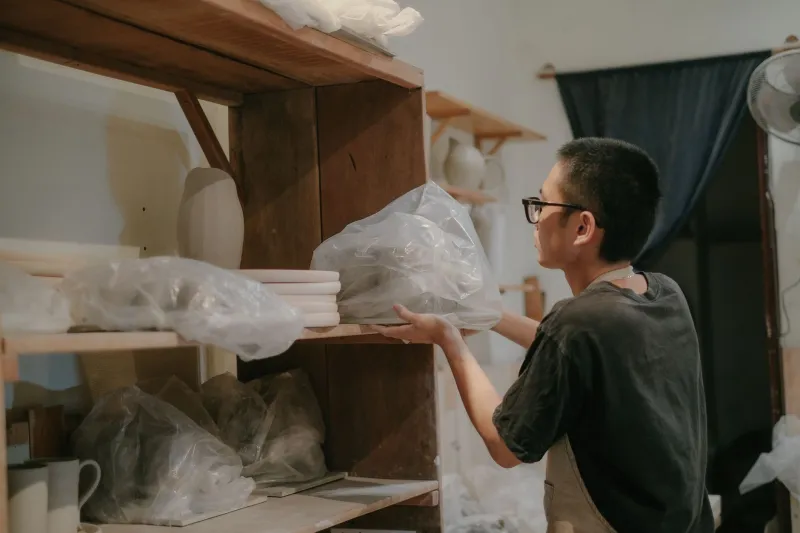
Jasmine Okafor, a ceramicist in Detroit who sells her work through a combination of local galleries and her own website, describes her early years in pottery as "trying to clone other people's pots." She was technically competent. She was also miserable.
"Everything I made looked like a slightly worse version of something I'd seen online," she says. "I had no idea what my voice even was, because I'd never had to find it. I was just following a map someone else drew."
The turning point came when her kiln malfunctioned and fired a batch of pieces at the wrong temperature. The results were warped, cracked, and covered in unexpected surface texture. They were also, she says, the first pieces she'd ever made that felt like hers.
"I started chasing that," Okafor says. "Not the malfunction specifically, but the surprise. The thing I didn't plan for. Now I build uncertainty into every piece on purpose. I'll change the clay body mid-project, or fire something without knowing exactly what glaze I used. The not-knowing is the whole point."
The Anti-Tutorial in Practice
So what does this actually look like as a practice? Because "throw out the instructions" sounds liberating in theory and terrifying in the supply aisle at your local craft store.
For most of the makers living this philosophy, it's less about chaos and more about shifting where the authority lives. Instead of asking "what does the tutorial say to do next?", they're asking "what does the material want to do?" or "what happens if I try this?"
Reyes describes her current process as "aggressive conversation with the medium." She'll start a resin piece with a loose idea — a color story, a mood, a texture she's curious about — and then respond to what the material does rather than trying to force a predetermined outcome.
"Resin has opinions," she says, laughing. "It wants to do certain things. If you fight it, you get frustration. If you follow it, you get something you couldn't have planned."
Tillman takes a more structured approach to unstructured making. He keeps what he calls a "wreck journal" — a physical notebook where he documents every failed build with photographs, notes on what went wrong, and ideas for how to use the failure as a starting point for something new. Some of his most popular pieces trace directly back to a specific disaster in that journal.
"A failed joint became a signature joinery style," he says. "A piece I cut wrong became a design element. My wreck journal is basically my portfolio of accidental innovation."
The Community Building Around Beautiful Mistakes
What's interesting is how this philosophy is generating genuine community. In an online craft landscape dominated by aspirational content and impossible standards, the makers who share their failures are finding audiences hungry for something real.
Okafor's most engaged social posts aren't her finished pieces. They're the ones where she shows a cracked bowl and explains what she learned from it. Tillman's most-shared content is a video series called "What Went Wrong" where he walks through failed builds without solutions — just honest documentation of the problem.
"People are starving for permission to fail," he says. "The tutorial economy tells you there's a right way. I'm just showing people there isn't."
There's something almost political about it, if you squint. In a maker culture increasingly shaped by algorithm-friendly aesthetics and brand partnership content, choosing to learn through failure is a small act of defiance. It's saying the process matters more than the product. It's saying your weird, imperfect, hard-won thing has more value than a perfect replica of someone else's idea.
Your Turn to Break Something
If you've been white-knuckling your way through tutorials and wondering why your work doesn't feel like yours, consider this your permission slip.
Pick a material you're curious about. Give yourself an afternoon and no instructions. Make something bad. Make something weird. Make something you have to explain to people at your next craft fair, and watch how they lean in.
The outlaws aren't the ones burning tutorials for fun. They're the ones who realized the tutorials were burning something in them — the instinct, the intuition, the specific and unrepeatable thing that makes your work yours.
Break something. See what's inside it.
That's where the real craft lives.